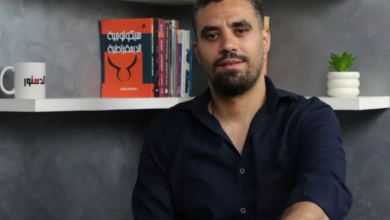
Ramadan Without Bars | Mohamed Adel: Years of “Bitter Waiting” for the Dream of Breaking the Fast in Freedom

The Egyptian Center for Economic and Social Rights (ECESR) takes advantage of the holy month of Ramadan—symbolic of justice, mercy, and tolerance—to renew its ongoing calls for the immediate release of individuals detained in cases related to freedom of opinion, whether held in pretrial detention or serving final sentences.
In this context, the Center launches its “Ramadan Without Bars” campaign, which includes a series of articles highlighting the cases of individuals imprisoned in opinion-related cases, with the aim of demanding that they—and all others similarly detained—be granted the freedom to which they are legally and morally entitled.
Every Ramadan, Rafida Hamdy sits at the iftar table, contemplating the empty chair left by her husband, Mohamed Adel, a political activist who has been imprisoned for more than twelve years. She can no longer recall how many times he has been absent from the Ramadan table; the repetition of these moments has rendered them a painful constant in her life.
Each time Rafida prepares to visit Adel in prison, carrying the iftar meal she prepares with love and longing, she heads to Tenth of Ramadan Prison, to which he was recently transferred following his forcible relocation from high-security Gamasa Prison at the end of December 2024. With every visit, she hopes it will be different—one that carries news of an imminent release.
She waits for visiting hours to arrive. She sees her husband, and they exchange smiles and warm words, attempting to transcend prison bars through love and resilience. She asks about his conditions, tells him about her daily life, and shares the hope filling her heart—that they will soon reunite around the iftar table in their own home.
As the visit ends, she bids him farewell with tear-filled eyes, wishing this would be the last time she sees him behind bars. She returns home to face the empty chair once again, clinging to faith that they will soon reunite without barriers, and that his seat will no longer remain vacant.
Mohamed Adel, born on 8 August 1988, was a young man driven by enthusiasm and a vision for a better future for his country. He began his political activism with the Kefaya Movement in 2005, contributed to calls for the 6 April 2008 general strike, and later became one of the founders of the April 6 Youth Movement. In 2009, he served as the movement’s official spokesperson, articulating the hopes and aspirations of Egyptian youth.
However, his path of activism was fraught with hardship. On 22 December 2013, Mohamed was sentenced to three years’ imprisonment with hard labor and a fine of EGP 50,000, on charges of violating the Protest Law and assaulting police officers. After serving his sentence, he was subjected to arbitrary police probation for one and a half years.
In June 2018, he was rearrested on charges related to his political activity and the exercise of his rights to freedom of expression, organization, and peaceful assembly. He remained in pretrial detention for five years without a fair trial. In September 2023, the Aga Misdemeanor Court in Mansoura sentenced him to four years’ imprisonment on charges of publishing “false news” on social media.
According to his wife and lawyer, Mohamed is expected to complete his sentence in September 2027, as the period of pretrial detention was not deducted from the sentence, although he should have been released in January 2025 had it been counted.
Throughout his detention, Mohamed’s health condition has deteriorated significantly. Since 30 May 2022, he has suffered from peripheral neuropathy, knee joint inflammation, and chest pain, without receiving adequate medical care. In May and July 2024, he was admitted to the prison hospital due to worsening health. Medical assessments indicated that his condition was aggravated by lack of exposure to sunlight and the absence of physical therapy, yet the prison hospital limited treatment to painkillers and mild medication.
On 26 July 2024, Mohamed announced a hunger strike in protest against the extension of his detention and the restrictions imposed on him inside prison. Despite his deteriorating health, the prison administration refused to officially document the hunger strike. In March 2024, officers from the National Security Agency threatened him with solitary confinement or transfer to another prison with harsher detention conditions, in retaliation for his demands to improve his conditions at Gamasa Prison.
Rafida, who has borne the weight of these years with patience and strength, has repeatedly appealed to the authorities for her husband’s release. In September 2024, she submitted a petition addressed to President Abdel Fattah El-Sisi, calling for a presidential pardon for her husband. In May 2024, 80 Egyptian and international human rights organizations demanded Mohamed’s immediate release, noting that Gamasa Prison authorities deprived him of adequate nutrition, further endangering his health.
Today, Mohamed Adel enters his thirteenth year behind bars, amid ongoing suffering and harsh detention conditions. Rafida, whose dreams have faded with the continuation of his imprisonment, hopes that this Ramadan will be the last he spends behind bars, and that they will reunite to begin a new life free from pain and hardship.
During his detention, she has spoken publicly about the harassment he has endured and the decline in his health, citing chronic pain and knee and shoulder problems, and has repeatedly demanded that he be provided with necessary medical care.
On 13 February 2025, Rafida addressed a message calling for an end to her husband’s detention, emphasizing that he has not committed acts of violence or incitement, and that the continuation of his imprisonment has cast a heavy shadow over their family life—particularly as the prolonged absence has delayed their hope of building a stable family. She stressed their desire to close the chapter of political conflict and live peacefully, appealing for an end to their ordeal, which has now lasted more than a decade.
On this occasion, calls are renewed for the release of Mohamed Adel and all those detained in cases related to freedom of opinion and expression, so that they may return to their families and reclaim their inherent right to freedom, and so that Ramadan may no longer be lived behind bars.